A changing climate with hotter and drier weather is a challenge for people, but also for lakes, reservoirs and rivers. The Rio Grande river, which runs from Colorado into Mexico, crossing several U.S. states, continues to shrink and to run dry in places where it used to flow.
Most of the water from the river is used to grow crops like alfalfa and hay to feed livestock, Other crops are cotton and pecans; some water is used for power generation and some for municipal water use. But the river can no longer provide enough water for all those uses. The World Wildlife Fund has made it their mission to revitalize the river. It’s a daunting task, one faced by my guest, Enrique Prunes, Rio Grande Manager and Freshwater Lead Specialist at World Wildlife Fund US.
Play podcast
Featured on this program...
Check local listings for stations on the Pacifica Network carrying Mothering Earth or…
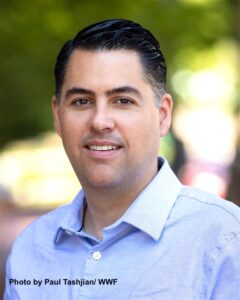
Enrique Prunes, Rio Grande Manager and Freshwater Lead Specialist
Enrique Prunes is the Rio Grande Manager and Freshwater Lead Specialist at WWF US. In his role, he works across the Freshwater and Food team to incorporate the connections of surface water, groundwater, and agricultural water consumption into all the team initiatives and beyond. He leads the programmatic work in the Rio Grande/Rio Bravo including continued partnership development, donor cultivation, and strategic decision-making around program direction, and implementation.
He serves as the primary focal point on the Freshwater team for issues and solutions related to agricultural water management, groundwater, and surface water hydrology, and related science and policy areas to address the drivers and threats to biodiversity and freshwater ecosystems due to changes in agriculture and water scarcity challenges globally. He also supports the development of the Science-Based Targets methodology for freshwater, water balance, and resource accounting models that link groundwater and surface water systems, and guidance on downscaling of climate change scenario planning.
Prior to WWF-US, Enrique worked at WWF-Mexico, where he spent more than 10 years in the Water Program and the Chihuahuan Desert Programs. He originally started as a consultant for hydrologic modeling and monitoring, environmental flow assessment, Integrated Water Resources Management, and Nature-Based Solutions implementation within the Rio Grande/Bravo basin. After that, he worked as the Science and Monitoring & Evaluation Coordinator for the GEF Sustainable Tarahumara project for landscape integrated management and connectivity and biodiversity conservation in the Sierra Tarahumara Mountain range in Mexico, in collaboration with WWF, UN Environment, and the Mexican Federal Government.
To hear Mothering Earth podcasts...
Check Mothering Earth on your favorite podcast platform using the links below. For more recent programs, check out our Archives page.
Since it began in 2015, Mothering Earth has been bringing listeners informative programs on a broad range of environmental and sustainable living topics .